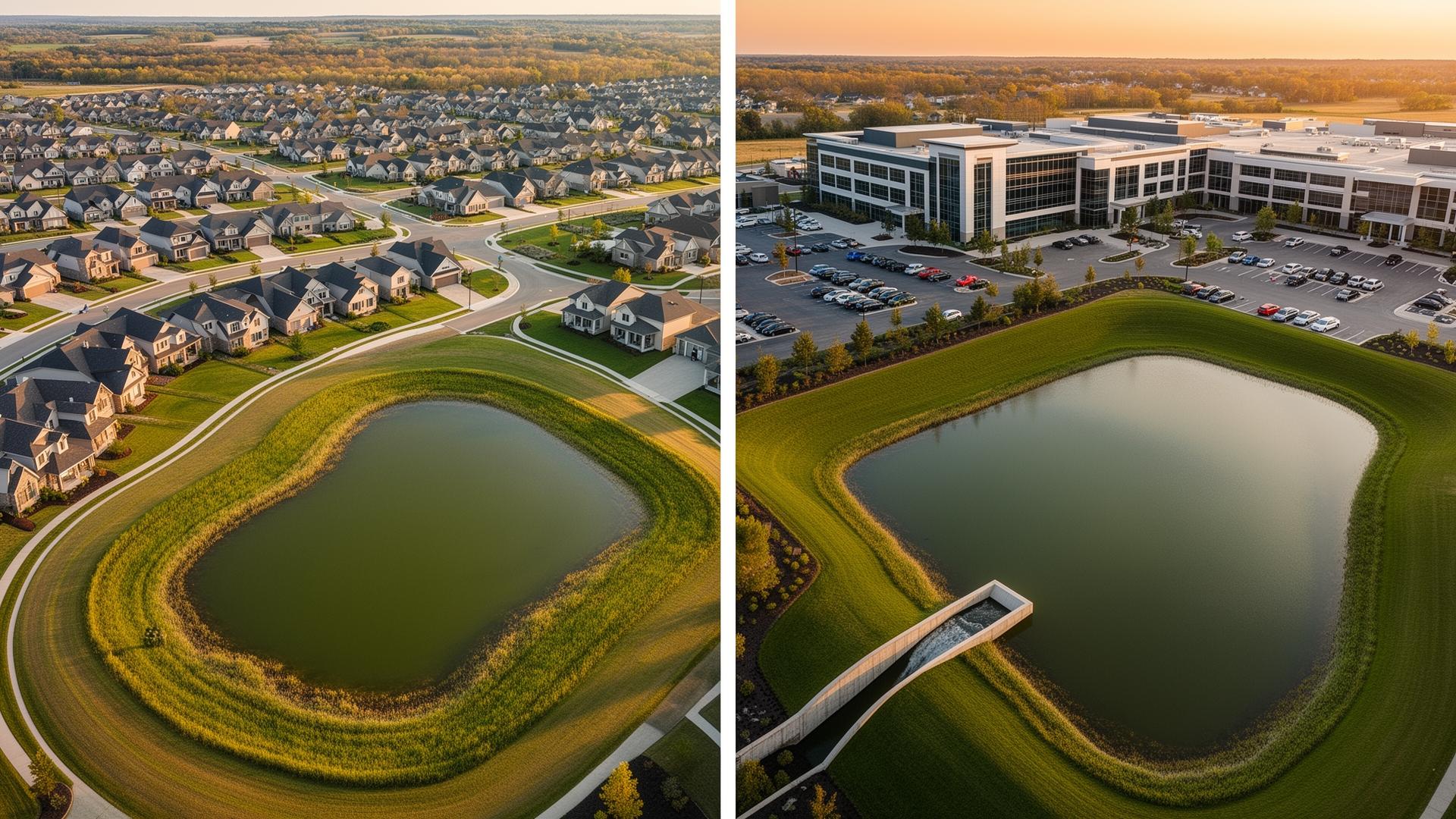
Detention and retention ponds are not just big holes. They are designed volumes with compacted clay benches, engineered emergency spillways, and outlet controls sized to the contributing drainage area. Pick the wrong basin type and you either pay for maintenance you didn't budget or fail the stormwater inspection you have to pass.
We build four main kinds of stormwater basin in the Upstate. Wet ponds hold a permanent pool and treat runoff long-term. Dry detention basins sit empty most of the year and only store water during storms. Bioretention cells filter smaller flows through engineered soil and plants. Sediment basins are temporary construction-phase traps that keep mud off the road and out of the stream.
The right choice comes down to your drainage area, your soils, how much room you have, and what the approved stormwater plan calls for. We walk the site with you, review the plan, and recommend the basin — or combination — that keeps you compliant without overspending.
We do not stamp plans or act as the engineer of record. We build to your approved stormwater plan, coordinate with your civil engineer, and keep the work permit-ready for SCDHEC-NPDES and county stormwater review. If you don't have plans yet, we'll tell you exactly what you need before anything gets dug.
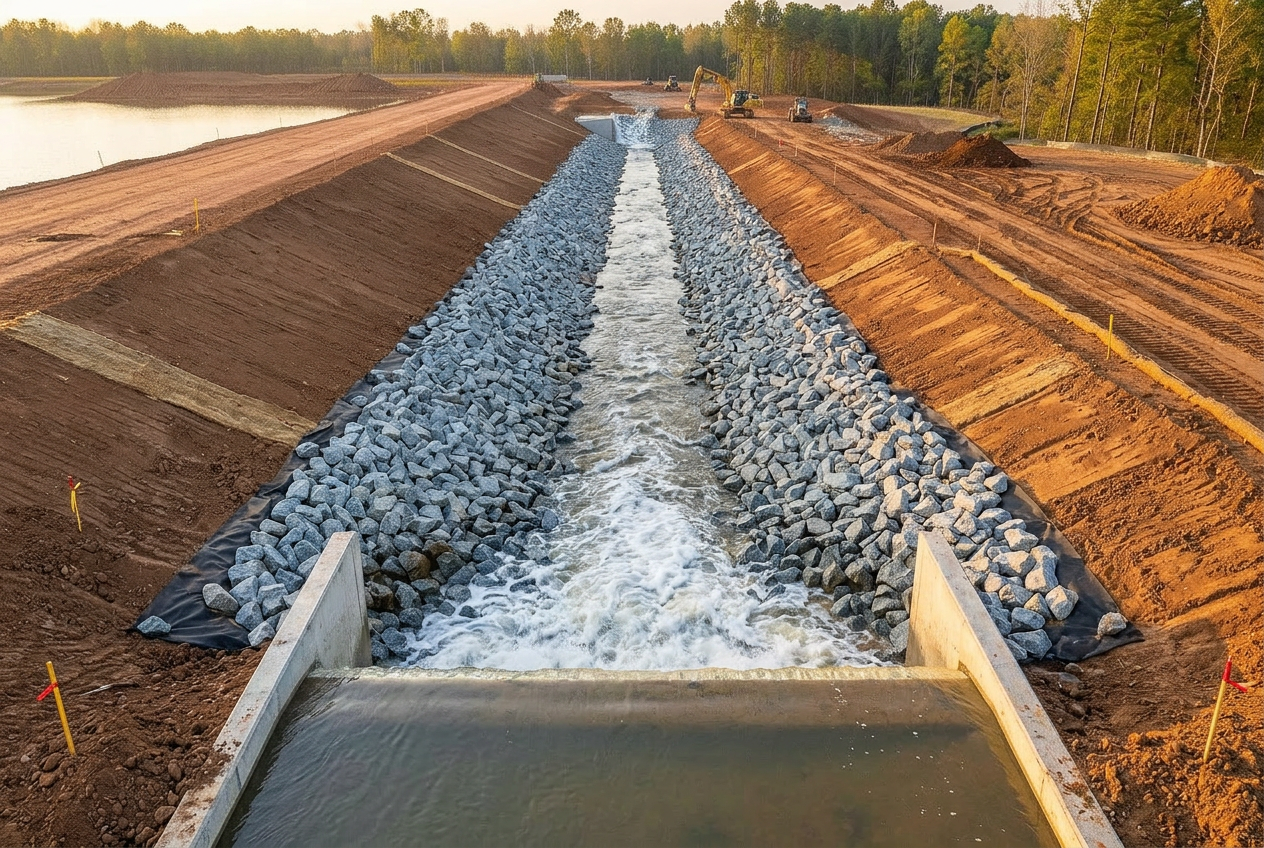
Emergency spillway pour with Class B riprap armoring over non-woven filter fabric — built to handle the 25-year storm without scouring.
Systems we install
Four stormwater basins we build — and how we help you choose.
Not sure which one fits your property? That's our job. We walk the site with you, look at the soil and the slope, and recommend the system — or combination of systems — that actually solves the problem. No upsell, no guesswork.
Wet ponds
Best for: Commercial sites, subdivisions, permanent water treatment
A permanent pool of water with landscaped side slopes and a stable outlet structure. Wet ponds treat pollutants between storms and look like a planned landscape feature once established. Higher maintenance than dry basins, but the best long-term water quality option when you have the room.
Dry detention basins
Best for: Residential developments, schools, parking lots with limited space
Grass-bottomed basins that sit dry most of the year and only store runoff during a storm. They slow peak discharge to pre-development rates and are usually the lowest-maintenance option for sites that just need volume control, not permanent treatment.
Bioretention cells
Best for: Parking lot islands, small commercial sites, tight footprints
Shallow excavated areas filled with engineered soil, gravel, and native plants that filter and slow smaller runoff flows. Often called rain gardens, they handle water quality at the source and fit where a full pond won't.
Sediment basins
Best for: Active construction sites, land-disturbance permits, phased developments
Temporary settling ponds built to trap sediment-laden runoff before it leaves the site. Required on most land-disturbance jobs, and built to be cleaned out or converted to permanent stormwater control as the project moves forward.
Why it matters
What you get when it's done right.
Permit-ready
Built to SCDHEC and county stormwater standards with as-built documentation.
No downstream lawsuits
Outlet structures sized so peak discharge matches predevelopment rates.
Long service life
Properly compacted clay liners and rip-rap armoring at high-velocity points.
Inspection support
We meet the inspector on-site and turn the punch list around in days, not weeks.
Our process
From first call to final walk-through.
Step 01
Survey & soil eval
Topo shoot, soil borings if needed, confirm seasonal high water table.
Step 02
Design alignment
Coordinate with your engineer on volume, spillway elevation, outlet type.
Step 03
Excavation
Track-hoe excavation, off-haul or on-site spoil placement, bench compaction.
Step 04
Structures & seed
Spillway pour, outlet install, riprap, native seed mix on side slopes.
Straight answers
Retention Ponds questions we get asked.
What drives the cost of a retention or detention pond?
Volume, soil, and outlet structure. How much water the plan requires you to hold, what we hit when we dig, and what the engineered outlet and spillway have to be. We price off the approved plan and put it in writing before we mobilize.
How long does pond construction take?
A small residential detention basin can be a week. A commercial pond with an engineered riser, anti-seep collar, emergency spillway, and riprap armoring typically runs two to five weeks depending on weather and inspection timing.
Do I need permits and an engineer?
For stormwater retention or detention on a development, almost always. That means a stamped stormwater plan and land-disturbance approval, and often SCDHEC involvement. We build to the approved plan and coordinate with your engineer — we don't design around the permit.
Can ponds be built in winter?
Yes, and dam work in particular benefits from cooler weather. What we watch is soil moisture: clay has to be placed and compacted near optimum moisture, so a stretch of hard rain will push placement days. We plan the sequence around that instead of fighting it.
What do you need from me to get started?
The stormwater plan and grading plan if you have them, the permit status, and site access. If you don't have plans yet, we'll walk the site and tell you what you'll need before anything gets dug.